16th September 2026
The Most Important Question Leaders Should Ask About AI
By David Hassell, Co-founder and Vice Chairman of 15Five
I have spent more than 15 years building technology to help organizations unlock the potential of their people. Now, as AI reshapes work, nearly every leadership conversation contains some version of the same fear: Will AI replace jobs, make hard-earned skills obsolete, or leave companies behind?
Those are valid questions. It would be irresponsible to deny that AI will disrupt roles and eliminate some work. But fear is much better at showing us what could go wrong than imagining what could go right.
Leaders have a responsibility to hold both truths at once: AI creates meaningful risk, and it also creates new capacity. What happens next is not dictated by the technology alone.
AI creates capacity. Leadership decides what it is for.
The most common question I hear from executives about AI is about efficiency: How can we do the same work with fewer people?
Efficiency matters. Leaders must remove low-value work, invest capital wisely, and build competitive organizations. Sometimes a smaller team is the right business decision.
But if efficiency becomes the only lens, we risk using AI merely to do yesterday’s work more cheaply rather than asking what new work it makes possible.
In a widely shared exchange with CNBC host Jim Cramer, NVIDIA CEO Jensen Huang challenged leaders to consider why greater productivity should automatically lead to contraction. His point was that companies with imagination can use AI to do more with more.
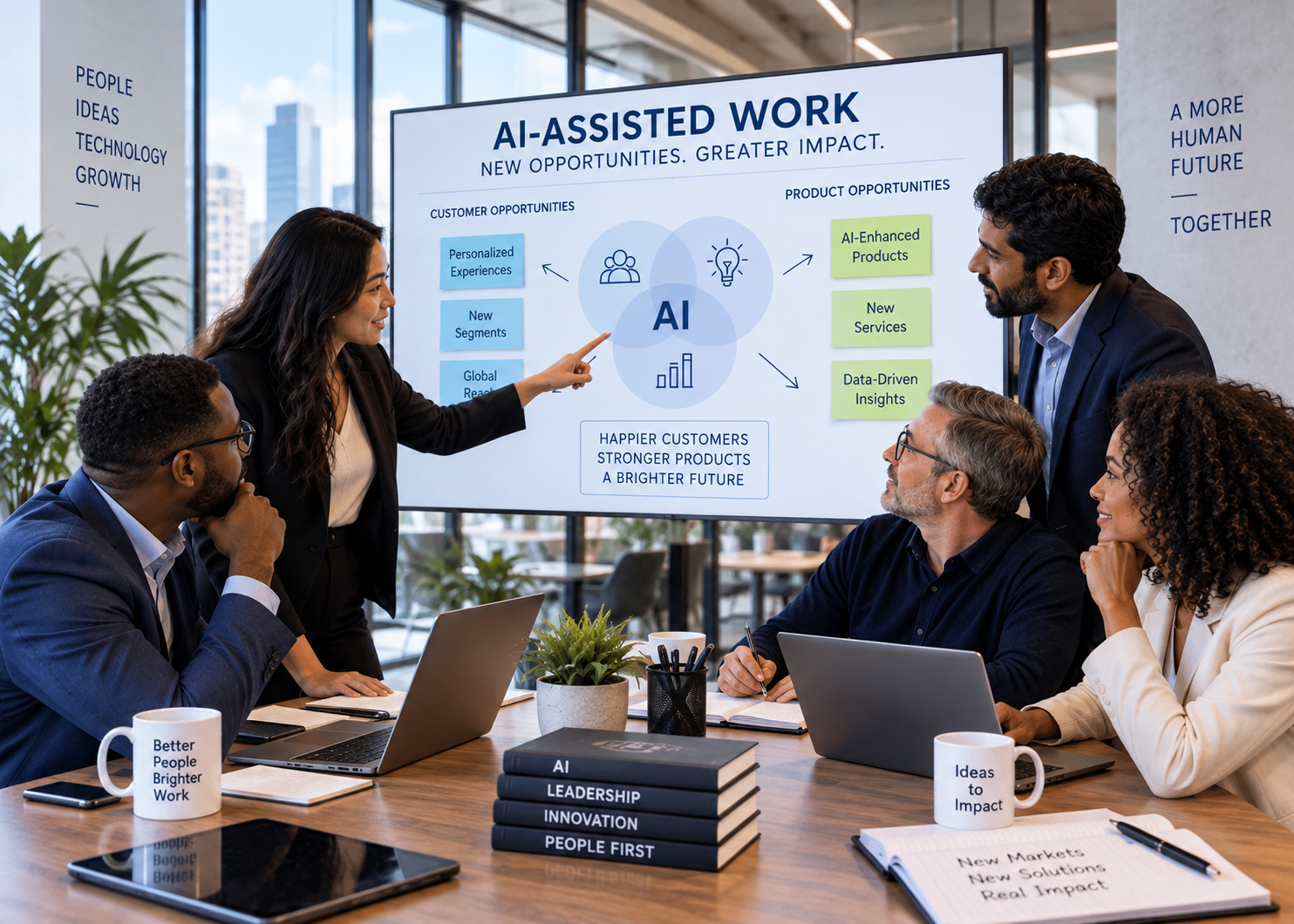
That leads to a better question: What becomes possible now that our people can accomplish so much more?
One company may use AI to automate tasks, hold output constant, and reduce headcount. Another may use the same capability to improve quality, shorten learning cycles, serve customers who were previously uneconomical to reach, and pursue products that once sat outside the realm of possibility.
AI does not choose between those futures. Leadership does.
When the constraint moves, ambition can expand
While studying at Tufts, I met Art Papas, founder and CEO of Bullhorn, a global provider of cloud software for the staffing and recruitment industry. Bullhorn’s experience offers a useful example.
Bullhorn found that AI could reduce weeks of product development work to hours. The initial assumption was that the company would need fewer engineers. Instead, the economics of adding excellent engineers became more attractive. Repetitive work declined, the product roadmap expanded, and Bullhorn hired more engineers to pursue opportunities that had not previously been practical.
This pattern is not guaranteed, but it is strategically important. When a valuable capability becomes cheaper or more abundant, demand for it can expand. Cheaper computing did not make the world want less software. Better digital distribution did not make organizations communicate less. More abundant intelligence, analysis, and creation may similarly expand the number of worthwhile problems a company can solve.
Start with value, not an inventory of tasks
Many AI programs begin with a task audit: Which activities can we automate? Which roles contain repetitive work? Where can we save hours?
That can create quick wins, but it can also trap the organization inside its current operating model. Automating a task preserves the assumption that the task – and the surrounding workflow – should exist in its present form.
Before deciding what to automate, leaders should ask four questions:
- What valuable work are we not doing because it is currently too slow, expensive, or difficult?
- Which human capabilities become more important when routine production becomes abundant?
- How would we redesign the entire workflow if we were starting today?
- Where must a human remain accountable for the outcome?
Consider a manager preparing for a performance conversation. The narrow question is whether AI can draft the review faster. The more thoughtful question is whether AI can help the manager see a fuller picture – recognize contributions that might otherwise have been missed, identify coaching opportunities sooner, and spend more of the conversation on judgment and growth.
The first saves time. The second improves leadership. The strongest applications do both.
Give people a future they can help build
Employees will reasonably worry about what AI means for their jobs. Vague reassurance will not build trust, and neither will a cost-cutting mandate dressed up as inspiration.
Leaders should be candid about uncertainty while inviting employees to help redesign the work. The people closest to a workflow understand its friction, exceptions, and unrealized opportunities. Involving them is not just considerate change management; it is one of the best ways to discover where AI can create real value.
The winners will not simply be the organizations that deploy the most AI. They will be the ones that combine AI’s speed and scale with human imagination, judgment, and ambition.
The question, then, needs to shift from: How can we do more with less, to how can we do more with more?
About the author
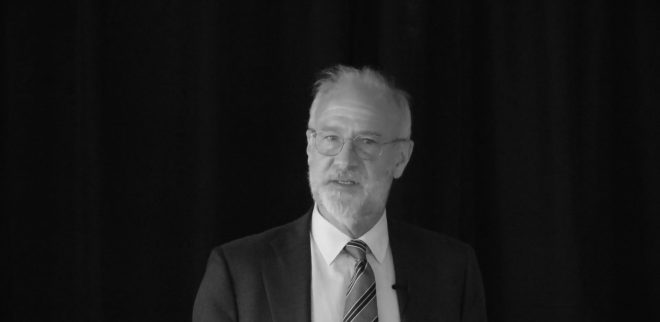
David Hassell is the co-founder and Vice Chairman of 15Five, an AI-powered performance management platform. For more than 15 years, he has worked with organizations to help managers become more effective and unlock the potential of their people. Connect with David on LinkedIn.
Further reading
NVIDIA: Jensen Huang on AI infrastructure, opportunity, and the future of work